X-ray screening operations exist within a complex regulatory framework spanning aviation security, radiation safety, occupational health, and international trade. Understanding applicable regulations is critical for compliance, certification, and safe operations.
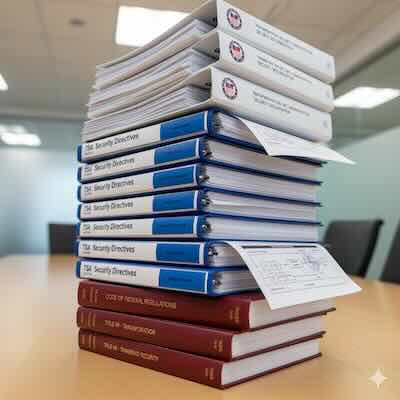
Federal regulations governing X-ray screening operations and compliance
U.S. Federal Regulations
TSA - Transportation Security Administration
49 CFR Part 1540 - Civil Aviation Security: General Rules
Foundation regulation establishing TSA authority and basic security requirements:
- §1540.105: Inspection authority - TSA access to airports and screening areas
- §1540.107: Submission to screening - Passenger and baggage inspection requirements
- §1540.109: Prohibition against interference - Penalties for obstructing screening
- §1540.111: Carriage of weapons, explosives, and incendiaries
49 CFR Part 1542 - Airport Security
Requirements for airport operators:
- Airport Security Program (ASP) development and maintenance
- Security Coordinator designation
- Exclusive Area Access controls
- Law enforcement support requirements
- Incident response protocols
49 CFR Part 1544 - Aircraft Operator Security
Passenger airline security obligations:
- Subpart C: Operations (screening checkpoint procedures)
- §1544.201: Acceptance and screening of individuals
- §1544.203: Acceptance and screening of checked baggage
- §1544.207: Screening of individuals and accessible property
- §1544.229: Fingerprint-based criminal history records checks
49 CFR Part 1546 - Foreign Air Carrier Security
International airline operations at U.S. airports:
- Foreign Air Carrier Security Program requirements
- U.S. equivalency demonstrations
- Last Point of Departure (LPD) airport standards
49 CFR Parts 1548/1549 - Air Cargo Security
- Part 1548: Indirect Air Carrier (IAC) security requirements
- Part 1549: Certified Cargo Screening Program (CCSP) standards
- §1549.7: Approval requirements and procedures
- §1549.101: Acceptance, screening, and transfer of cargo
Security Directives (SDs) and Emergency Amendments (EAs)
Classified operational directives issued by TSA (not publicly available):
Common Security Directives
- SD 1544-21-01: Passenger and Accessible Property Screening Procedures
- SD 1544-04-04: Checked Baggage Screening Procedures
- SD 1544-05-01: Known Crewmember Program
- SD 1546-04-05: Foreign carrier security requirements
- SD 1549-04-01: Air cargo screening procedures
Access and Compliance
Security Directives are:
- Sensitive Security Information (SSI): Protected under 49 CFR Part 1520
- Distribution: Only to individuals with need-to-know (airport/airline security coordinators)
- Effective Date: Immediate upon issuance
- Penalties for Violation: Civil penalties up to $13,910 per violation per day (2026 adjusted)
FDA - Food and Drug Administration
21 CFR Part 1020.40 - Cabinet X-Ray Systems
Federal performance standard for enclosed X-ray screening equipment:
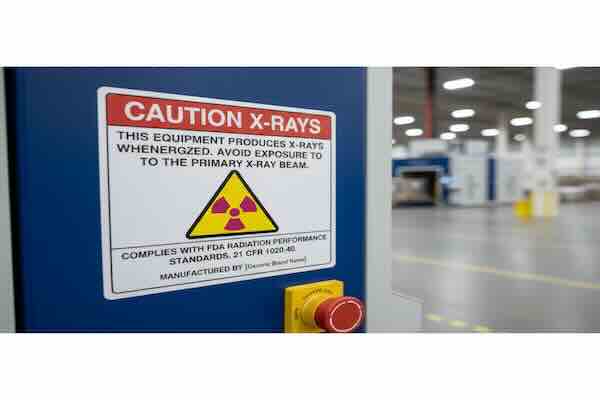
FDA-required warning label on cabinet X-ray screening equipment
Design Requirements (§1020.40(c))
- Radiation Emission Limit: <0.5 millirem per hour at any point 5cm from external surface
- Primary Protective Barrier: Shielding surrounding X-ray generation and imaging area
- Safety Interlocks: Minimum two independent systems preventing X-ray emission with door open
- Fail-Safe Design: Interlock failure must result in X-ray termination
- Warning Labels: Specific verbiage and placement requirements
Warning Devices (§1020.40(c)(3))
- Visual Indicator: Clearly visible "X-RAY ON" light
- Location: Near all access points to primary barrier
- Activation: Illuminated only when X-rays are being generated
Labeling Requirements (§1020.40(g))
- Manufacturer name and address
- Model and serial number
- Manufacturing date
- Required warning statements (specific FDA text)
21 CFR Part 1002 - Records and Reports
- Manufacturing Reports: Product reports and annual certification
- Assembly Reports: Installation documentation
- Defect Reporting: Notification within 5 business days
- Accidental Radiation Occurrence Reporting: 15-day notification requirement
State Radiation Control Programs
Individual states regulate radiation-producing machines through state health departments:
Registration Requirements
| Requirement | Details |
|---|---|
| Equipment Registration | Pre-operational notification, annual renewal |
| Inspection Fee | $100-$500 annually (state-dependent) |
| Radiation Safety Officer | Designated individual for high-energy systems |
| Operator Training | Documentation of competency (some states) |
| Shielding Plans | Required for LINAC installations >1 MeV |
Conference of Radiation Control Program Directors (CRCPD)
Suggested State Regulations (SSR) provide model legislation:
- Part J: X-Ray and Gamma-Ray Radiographic Installations
- Part G: Use of Radiation Machines in the Healing Arts
- Part H: Requirements for Cabinet X-Ray Systems
OSHA - Occupational Safety and Health Administration
29 CFR 1910.1096 - Ionizing Radiation
Worker protection standards:
Exposure Limits
- Whole Body: 1.25 rem per calendar quarter (5 rem annual)
- Extremities: 18.75 rem per calendar quarter
- Radiation Area: >5 millirem in one hour at 30cm
- High Radiation Area: >100 millirem in one hour at 30cm
Monitoring Requirements
- Personnel Dosimetry: Required for workers potentially exceeding 10% of limits
- Area Surveys: Documented radiation level measurements
- Signage: Caution signs for radiation and high radiation areas
- Training: Annual instruction for exposed workers
International Regulations
ICAO - International Civil Aviation Organization
Annex 17 - Security: Safeguarding International Civil Aviation Against Acts of Unlawful Interference
Global standard for aviation security (binding for 193 contracting states):
Key Provisions
- Standard 4.1: Each contracting state shall establish a national civil aviation security program
- Standard 4.6: 100% screening of passengers and their carry-on baggage
- Standard 4.7: Screening or security controls for checked baggage
- Standard 4.9: Security controls for cargo and mail
- Standard 5.1: Quality control program including testing and compliance inspections
Recommended Practices
- Recommended Practice 4.6.3: Use of dual-energy X-ray or equivalent for baggage screening
- Recommended Practice 4.7.1: Explosive detection systems for checked baggage
- Recommended Practice 4.9.1: X-ray screening for cargo and mail
ICAO Security Manual (Doc 8973)
Restricted distribution guidance document providing detailed implementation procedures (available only to states and authorized entities):
- Volume I: National Organization and Administration
- Volume II: Preventive Security Measures
- Volume III: Response Procedures
ECAC - European Civil Aviation Conference
Doc 30 - Common Evaluation Process
European certification standards for security equipment:
Hold Baggage Screening Standards
| Standard | Capability | Technology |
|---|---|---|
| Standard 1 | Basic threat detection | Single-energy X-ray |
| Standard 2 | Enhanced detection (C-1 explosives) | Dual-energy X-ray |
| Standard 3 | Advanced detection (C-1 to C-4) | CT or advanced dual-energy |
Cabin Baggage Screening (C-Points)
- C1: Basic metal detection
- C2: Single-energy X-ray
- C3: Dual-energy X-ray with material discrimination
- C4: Advanced imaging (CT or millimeter wave)
- C5: Explosive detection with automated threat recognition
EU Regulation 2015/1998
European Commission implementing regulation on detailed security measures:
- Screening methodology specifications
- Equipment performance standards
- Screener training requirements (minimum 40 hours initial, 8 hours annual)
- Quality control and testing protocols
Other International Standards
IEC 62523 - Baggage Inspection Equipment
International Electrotechnical Commission standard for determining imaging performance:
- Steel penetration testing methodology
- Wire resolution measurement
- Image quality metrics
- Spatial resolution and contrast sensitivity
ISO/IEC 27001 - Information Security Management
Relevant for systems with networked components and data storage:
- Security of screening image databases
- TIP performance data protection
- Operator credential management
Equipment Certification and Approval
TSA Qualified Products List (QPL)
Checkpoint and checked baggage equipment approved for use:
Certification Process
- Phase 1: Manufacturer submission with technical specifications
- Phase 2: Laboratory testing at TSA Systems Integration Facility
- Phase 3: Operational testing at live airport environments
- Phase 4: Data analysis and determination (6-18 months total)
Performance Metrics Evaluated
- Probability of Detection (Pd): Must exceed 95% for representative threats
- False Alarm Rate (FAR): Typically required <5% for operational efficiency
- Throughput: Minimum bags per hour requirement
- Image Quality: IEC 62523 compliance
- Reliability: Mean Time Between Failures (MTBF)
Air Cargo Screening Technology List (ACSTL)
Equipment certified for air cargo explosive detection:
Certification Categories
- Explosive Detection System (EDS): Automated threat recognition
- Explosive Trace Detection (ETD): Chemical analysis systems
- X-Ray Systems: Transmission imaging (pallet/ULD scanners)
- Multi-Modal Screening: Combined technology systems
Compliance and Enforcement
TSA Inspection Authority
TSA conducts regular compliance inspections under 49 CFR §1540.105:
Inspection Types
- Compliance Inspections: Scheduled audits of Security Programs
- Covert Testing: Unannounced penetration testing with test articles
- Investigation: Response to incidents or allegations
- Random Inspections: Unscheduled operational observations
Civil Penalties
| Violation Type | Maximum Penalty (per occurrence) |
|---|---|
| Screening Procedure Violation | $13,910 (individual) / $556,400 (entity) |
| Security Program Violation | $556,400 per violation |
| Interference with Screening | $13,910 (passenger) |
| Carriage of Weapon | $15,000+ (adjusted 2026) |
Note: Penalties adjusted annually for inflation per Federal Civil Penalties Inflation Adjustment Act
State Radiation Control Enforcement
State health departments enforce equipment registration and radiation safety:
Common Violations
- Operation without current registration
- Failure to post required warning labels
- Interlock malfunction or bypass
- Excessive radiation leakage
- Lack of documented operator training
Enforcement Actions
- Notice of Violation: Corrective action required within specified timeframe
- Civil Penalties: $1,000-$10,000 per violation (state-dependent)
- Equipment Seizure: Immediate shutdown for serious hazards
- License Suspension: Prohibition on operation until compliance
Compliance Best Practices
Regulatory Management Program
- Compliance Officer: Designated individual tracking regulatory changes
- Subscription Services: TSA Security Directive distribution, Federal Register monitoring
- Internal Audits: Quarterly self-assessments against Security Program requirements
- Training Documentation: Comprehensive records retention (3-5 years minimum)
- Incident Reporting: Established protocols for regulatory notifications
Equipment Maintenance and Testing
- Preventive Maintenance: Manufacturer-specified service intervals
- Annual Certification: Radiation surveys by qualified health physicist
- Daily Operability Checks: Image quality test patterns
- TIP System Validation: Quarterly verification of threat library
- Spare Parts Inventory: Critical components for rapid repair