Computed Tomography (CT) checkpoint scanners represent the most significant advancement in aviation security screening since 9/11. TSA authorization of CT technology in 2017 allows passengers to keep laptops and liquids in bags, while automated explosive detection (AED) algorithms achieve detection rates exceeding human operators.
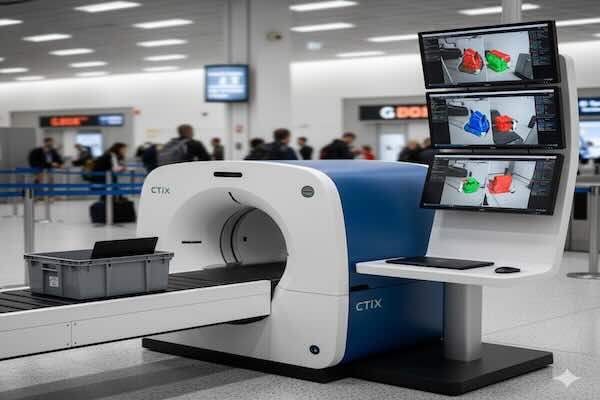
Advanced CT scanner with 3D imaging and automated threat recognition
CT vs. Conventional X-Ray Technology
Fundamental Differences
| Feature | Conventional 2D X-Ray | CT Scanner |
|---|---|---|
| Imaging Technique | Single transmission image | 360° volumetric reconstruction |
| Threat Detection | Operator visual identification | Automated explosive detection (AED) |
| Material Analysis | Dual-energy Zeff estimation | Precise density and atomic number mapping |
| Laptop/Liquid Removal | Required | Not required (TSA authorized) |
| Throughput | 300-400 bags/hour | 250-300 bags/hour |
| Cost | $80K-$150K | $300K-$500K |
Technical Architecture
Core Components
- X-Ray Source: Rotating tube assembly (120-140 kVp, continuous emission)
- Detector Ring: Multiple detector arrays capturing projections from all angles
- Reconstruction Computer: High-performance workstation for 3D image generation
- AED Algorithm: Machine learning models trained on explosive signatures
- Multi-Planar Display: Axial, coronal, and sagittal slice viewing
CT Scanning Process
- Bag Entry: Conveyor transports bag through tunnel (0.20 m/s typical)
- Data Acquisition: Detector captures 360° projections (500-1000 views)
- Image Reconstruction: Filtered back-projection or iterative algorithms create 3D volume
- Automated Analysis: AED software identifies suspicious regions
- Operator Review: Flagged bags examined with 3D manipulation tools
- Resolution: Clear or secondary screening (ETD, manual search)
Technical Specifications
| Parameter | Typical Value |
|---|---|
| Tunnel Size | 75 x 65 cm (slightly smaller than conventional) |
| Scan Time | 6-10 seconds per bag |
| Slice Thickness | 0.5-2.0 mm |
| Spatial Resolution | 0.5-1.0 mm (superior to 2D systems) |
| X-Ray Energy | 120-140 kVp |
| Power Consumption | 5-10 kW (higher than conventional) |
| Throughput | 250-300 bags/hour (algorithm dependent) |
Automated Explosive Detection (AED)
Detection Methodology
AED algorithms analyze multiple physical properties simultaneously:
- Density Measurement: Explosives typically 1.0-1.8 g/cm³
- Effective Atomic Number: Zeff range characteristic of organic explosives (7-8)
- Shape Analysis: Geometric patterns consistent with IED construction
- Contextual Assessment: Suspicious placement within bag (concealed in electronics)
- Mass Calculation: Volumetric measurement of potential explosive quantity
Machine Learning Models
Modern CT systems employ deep learning for threat recognition:
- Convolutional Neural Networks (CNNs): Image analysis for pattern recognition
- Training Data: Millions of threat and benign images from TSA libraries
- Continuous Learning: Algorithm updates based on operational performance
- False Alarm Reduction: AI distinguishes threats from harmless items (cosmetics, batteries)
Performance Metrics
| Metric | CT System | Conventional 2D |
|---|---|---|
| Probability of Detection (Pd) | >98% (automated) | 95% (operator dependent) |
| False Alarm Rate | 3-5% | 5-8% |
| Operator Workload | Reduced (review alarms only) | High (visual inspection of all bags) |
TSA Certification and Deployment
Regulatory Approval Process
- QPL Certification: TSA Qualified Products List testing (12-24 months)
- Performance Testing: Detection trials with representative threat articles
- Operational Pilot: Live airport deployment for validation
- Laptop/Liquid Authorization: Requires separate approval beyond basic QPL
U.S. Deployment Status
As of 2026, TSA has deployed CT scanners at:
- Major Hubs: JFK, LAX, ORD, ATL, DFW (complete coverage)
- Category X Airports: ~500+ CT units nationwide
- Expansion Goal: Full replacement of 2D scanners by 2030
- Investment: $1.2 billion TSA modernization program
Leading Manufacturers and Models
Analogic (Safran Detection)
ConneCT Series
- ConneCT 1000: First TSA-approved checkpoint CT (2017)
- Market Leader: Largest installed base in U.S. airports
- Features: 0.5mm slice thickness, automated bin return
Smiths Detection
CTiX Series
- CTiX: High-throughput CT with advanced AED algorithms
- Deployment: European and Asian airports primarily
- Features: Multi-energy spectral imaging, remote screening capability
Rapiscan Systems
RTT (Real-Time Tomography)
- RTT 110: Compact CT for checkpoint screening
- Technology: Proprietary tomographic reconstruction
- Features: Rapid scan times (under 6 seconds)
Nuctech
XT2080 Series
- Global Deployment: 100+ airports in China, Middle East, Africa
- Cost Advantage: 30-40% lower than Western competitors
- U.S. Restrictions: Not approved for U.S. airport use
Operational Benefits
Passenger Experience Improvements
- No Laptop Removal: Electronics remain in bags (TSA authorized)
- No Liquid Removal: 3-1-1 rule relaxed at CT-equipped checkpoints
- Reduced Divesting Time: 15-30 second savings per passenger
- Fewer Bag Checks: Lower false alarm rate reduces secondary screening
Security Enhancements
- Orientation Independence: Detects threats regardless of bag position
- Volumetric Analysis: Virtual dissection reveals concealed items
- Consistent Performance: Algorithm performance not subject to operator fatigue
- Small Threat Detection: Improved detection of minimal explosive quantities
Operational Efficiency
- Reduced Staffing: Single operator can monitor multiple lanes
- Remote Screening: Centralized image review from off-site facilities
- Training Simplification: Operators review alarms vs. interpreting all images
Deployment Considerations
Capital and Operating Costs
| Cost Category | Amount (USD) |
|---|---|
| Equipment Purchase | $300,000 - $500,000 |
| Installation and Integration | $50,000 - $100,000 |
| Annual Maintenance | $25,000 - $40,000 |
| Power/Utilities (annual) | $4,000 - $8,000 |
| Operator Training | $8,000 - $15,000 (initial) |
Infrastructure Requirements
- Floor Space: 6-8 meters length including roller tables
- Power: 208-240VAC, 40-60A dedicated circuit
- Cooling: Enhanced HVAC for high heat generation (10kW+)
- Network: Gigabit Ethernet for image transfer and remote screening
- Floor Loading: 300-400 kg/m² capacity
Future Developments
Technology Roadmap
- Spectral CT: Multi-energy imaging for enhanced material discrimination
- Faster Reconstruction: GPU-accelerated processing reducing scan times to 3-4 seconds
- AI Advancement: Explainable AI providing reasoning for threat detections
- Compact Designs: Smaller footprint systems for space-constrained checkpoints
- Checked Baggage Integration: Unified platform for both cabin and checked bags