Cargo X-ray scanners inspect millions of shipping containers, freight vehicles, and air cargo shipments annually, detecting contraband, weapons, and agricultural violations without physical unpacking. High-energy systems achieve penetration through fully loaded 40-foot containers using Linear Accelerator (LINAC) technology at 3-9 MeV.
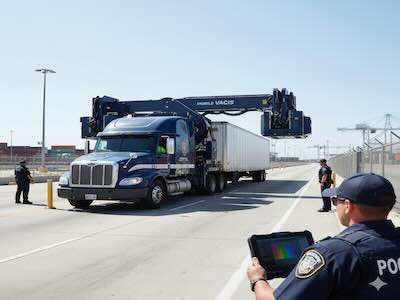
Drive-through cargo container inspection portal with high-energy X-ray
System Categories
1. Fixed Portal Systems
Permanent drive-through installations for high-volume screening:
Technical Specifications
| Parameter | Specification |
|---|---|
| Energy Range | 3-9 MeV (LINAC) or 1.2 MeV (Co-60 isotope) |
| Penetration | 300-400mm steel equivalent |
| Scan Time | 8-15 seconds per 40ft container |
| Throughput | 40-80 containers per hour |
| Resolution | 2-5mm wire detection capability |
| Maximum Vehicle Size | 4.5m (H) x 4.5m (W) typical |
| Power Requirement | 50-150 kW (LINAC systems) |
Design Configurations
- Single-View Portal: Horizontal beam scanning from one side
- Dual-View Portal: Horizontal + vertical beams for complete coverage
- Gantry Design: Overhead beam source with ground-level detectors
- Drive-Through Speed: 5-8 km/h during scanning
2. Mobile VACIS Systems
Vehicle and Cargo Inspection Systems for flexible deployment:
VACIS Technology Variants
- Mobile VACIS: Truck-mounted gamma-ray system (Co-60 or Cs-137 source)
- Z-Portal VACIS: Backscatter imaging for vehicle occupant detection
- Rail VACIS: Fixed systems for freight rail inspection
- VACIS II: Enhanced resolution with dual-energy capability
Operational Characteristics
| Feature | Mobile VACIS | Fixed Portal |
|---|---|---|
| Deployment Time | 20-30 minutes | Permanent installation |
| Scan Time | 2-5 minutes per vehicle | 8-15 seconds |
| Throughput | 12-20 vehicles/hour | 40-80 vehicles/hour |
| Cost | $1.5M - $2.5M | $3M - $6M |
| Flexibility | Multi-site deployment | Single location |
3. Air Cargo Screening Systems
TSA-certified equipment for air freight inspection:
Pallet/ULD Scanners
- Energy: 160-300 keV (lower than container systems)
- Tunnel Size: 2.5m x 3.0m typical (accommodates LD-3/LD-7 containers)
- Penetration: 75-150mm steel
- Throughput: 30-60 pallets per hour
- TSA ACSTL Certified: Air Cargo Screening Technology List approved
LINAC vs. Isotope Source Technology
Linear Accelerator (LINAC) Systems
Electrically-powered particle accelerators generating high-energy X-rays:
Advantages
- On/Off Control: Instant shutdown with no residual radiation
- Adjustable Energy: Selectable 3, 6, or 9 MeV for different cargo densities
- Deep Penetration: 400mm steel at 9 MeV
- No Radioactive Source: Eliminates dirty bomb theft concerns and NRC licensing
- Dual-Energy Capability: Material discrimination through spectral analysis
Disadvantages
- High Power Consumption: 100-150 kW during operation
- Complex Maintenance: Specialized technicians required for accelerator service
- Higher Capital Cost: $4M-$6M vs $2M-$3M for isotope systems
- Warm-Up Time: 15-30 minute initialization period
Cobalt-60 Isotope Systems
Radioactive source-based gamma-ray imaging:
Advantages
- Simplicity: No electrical power required for radiation generation
- Immediate Readiness: No warm-up time
- Lower Capital Cost: $2M-$3.5M
- Proven Technology: Decades of operational history
Disadvantages
- Fixed Energy: 1.17/1.33 MeV (cannot adjust)
- Limited Penetration: 200-250mm steel maximum
- Source Replacement: $300K-$500K every 5-10 years
- Security Concerns: Radioactive material requires NRC special nuclear material license
- Always Emitting: Mechanical shutter control (failure risk)
- Source Decay: Exponential decrease in intensity (5.3 year half-life)
Leading Manufacturers
Smiths Detection
HCV (High Cargo Volume) Series
- HCV Mobile: Truck-mounted LINAC for temporary deployments
- HCV Portal: Fixed gantry installation with dual-view imaging
- Energy: 3.5/6 MeV dual-energy for material discrimination
- Throughput: 60+ containers per hour
Rapiscan Systems
Eagle Series
- Eagle M60: Mobile VACIS with Co-60 source
- Eagle Portal: Drive-through LINAC system (4-9 MeV)
- Eagle Rail: Freight train inspection system
- Features: Z-Backscatter option for occupant detection
Nuctech (China)
XT Series
- XT100: Large-scale container inspection (3-9 MeV)
- Significant Market Share: Deployed at 100+ ports globally
- Cost Advantage: 20-30% lower than Western competitors
- U.S. Restrictions: CBP procurement prohibitions due to cybersecurity concerns
Leidos (formerly SAIC)
VACIS and EAGLE Systems
- VACIS XPL: Gamma-ray mobile inspection system
- EAGLE: Advanced mobile LINAC platform
- CBP Standard: Primary supplier for U.S. border operations
Deployment and Operations
Infrastructure Requirements
Fixed Portal Installation
- Footprint: 30-50 meters length for approach, scan zone, and exit
- Foundation: Reinforced concrete pad (30-50cm thick) for equipment
- Shielding: Concrete barriers (1-2m thick) or 15-30m exclusion zones
- Power Infrastructure: Three-phase 480VAC, 200-300A service
- Control Room: Climate-controlled operator station with workstations
- Network: Fiber optic or gigabit Ethernet for image transfer
Radiation Safety Zone
| Energy Level | Exclusion Radius | Shielding Alternative |
|---|---|---|
| Co-60 (1.2 MeV) | 15 meters | 1.0m concrete barriers |
| 3 MeV LINAC | 20 meters | 1.5m concrete barriers |
| 6 MeV LINAC | 25 meters | 1.8m concrete barriers |
| 9 MeV LINAC | 30 meters | 2.0m concrete barriers |
Operator Requirements
- Radiation Safety Training: 8-16 hours for high-energy systems
- Image Interpretation: 40-80 hours specialized cargo screening training
- Dosimetry Monitoring: Personal radiation badges required
- Annual Recertification: Competency testing and refresher training
Regulatory Compliance
United States
- NRC License: Required for radioactive sources (Co-60, Cs-137)
- State Registration: Radiation machine registration for LINAC systems
- OSHA 1910.1096: Occupational ionizing radiation exposure limits
- DOT 49 CFR 173: Transportation of radioactive materials
- CBP Approval: Equipment certification for U.S. port operations
International
- IAEA Safety Standards: International Atomic Energy Agency radiation safety
- WCO Framework: World Customs Organization equipment guidelines
- ISO 15390: Non-intrusive inspection system performance standards
Operational Performance
Contraband Detection Capabilities
High-Probability Detections
- Weapons: Firearms, ammunition, edged weapons (near 100% detection)
- Dense Contraband: Currency bundles, precious metals, electronics
- Concealed Compartments: False walls, hidden cavities in vehicles/containers
- Human Trafficking: Concealed persons in cargo areas
Moderate Detection Difficulty
- Narcotics: Organic materials require experienced operator interpretation
- Agricultural Products: Distinction from legitimate cargo challenging
- Explosives: Difficult without advanced dual-energy or CT
Throughput Benchmarks
| Facility Type | Daily Volume | System Type |
|---|---|---|
| Major Seaport | 500-1000 containers/day | Fixed portal (multiple lanes) |
| Land Border Crossing | 200-400 trucks/day | Fixed portal or mobile VACIS |
| Air Cargo Facility | 150-300 pallets/day | Pallet/ULD scanner |
| Special Event Security | 50-100 vehicles/day | Mobile VACIS |
Future Developments
Technology Enhancements
- Automated Threat Recognition: AI algorithms for contraband identification
- Multi-Energy Spectral Imaging: Beyond dual-energy for improved material discrimination
- 3D Reconstruction: CT-style volumetric imaging for cargo
- Faster Scanning: Sub-5-second inspection times with flash X-ray
Operational Improvements
- Remote Screening: Centralized image analysis from multiple ports
- Blockchain Integration: Immutable cargo tracking and screening records
- Smart Containers: RFID and IoT sensors for automated risk assessment
- 100% Scanning Mandate: U.S. SAFE Port Act implementation (phased rollout)