Advanced Imaging Technology (AIT) body scanners screen 2+ million passengers daily at U.S. airports, detecting concealed weapons, explosives, and contraband through clothing using non-ionizing millimeter wave radiation. Automated Target Recognition (ATR) software replaces invasive imaging with generic avatar displays, addressing privacy concerns while maintaining security effectiveness.
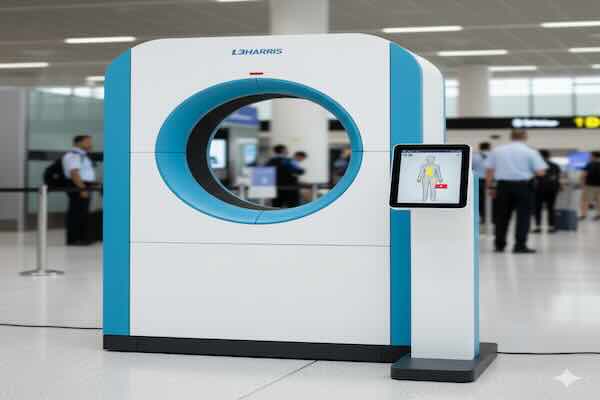
TSA checkpoint body scanner with automated target recognition
Technology Types
1. Millimeter Wave (MMW) Scanners
Non-ionizing electromagnetic radiation for passenger screening:
Technical Specifications
| Parameter | Specification |
|---|---|
| Frequency | 24-30 GHz (millimeter wave spectrum) |
| Radiation Type | Non-ionizing (no DNA damage risk) |
| Power Output | 10,000x less than cell phone |
| Scan Time | 2-3 seconds (full body coverage) |
| Penetration Depth | Clothing only (mm-scale) |
| Resolution | Sub-centimeter object detection |
Operating Principle
- Emission: Scanner emits low-power millimeter waves
- Reflection: Waves bounce off body and concealed objects
- Detection: Antenna array captures reflected signals
- Image Processing: Computer constructs 3D surface map
- ATR Analysis: Automated algorithm identifies anomalies
- Display: Generic avatar shows suspicious areas
2. Backscatter X-Ray (Discontinued)
Ionizing radiation technology phased out in U.S. (2013):
Why Discontinued
- Privacy Concerns: Detailed anatomical imaging
- Radiation Exposure: 0.05-0.1 µSv per scan (low but measurable)
- ATR Incompatibility: Couldn't meet privacy filter requirements
- Public Perception: Negative media coverage and opt-out rates
- Replacement: Millimeter wave systems provide equivalent security without ionizing radiation
Automated Target Recognition (ATR)
Privacy-Compliant Imaging
ATR software replaced detailed body images with generic avatars:
ATR Algorithm Functions
- Anomaly Detection: Identifies objects different from body surface
- Avatar Mapping: Marks suspicious areas on generic figure
- No Image Storage: Raw scan deleted immediately after analysis
- Operator Display: Only shows yellow boxes on avatar (location of threat)
- False Alarm Filtering: Ignores clothing seams, prosthetics (when declared)
Detection Capabilities
| Threat Type | Detection Capability |
|---|---|
| Metallic Weapons | 99%+ (firearms, knives, metal objects) |
| Non-Metallic Weapons | 95%+ (ceramic knives, plastic explosives) |
| Explosives (Body-Worn) | 90-95% (suicide vest detection) |
| Contraband | High (currency, drugs, packages) |
| Liquids/Gels | Moderate (size/location dependent) |
Major Manufacturers and Systems
L3Harris Technologies
ProVision Series
- ProVision 2: Original ATR-equipped millimeter wave scanner
- Market Share: Largest deployment in U.S. (1,000+ units)
- Scan Method: Dual rotating antenna panels
- Throughput: 150-200 passengers/hour
- Footprint: Compact (2m x 1m floor space)
Smiths Detection
eqo Series
- eqo: Advanced millimeter wave with 3D imaging
- Design: Open portal (less claustrophobic)
- International Deployment: European and Asian airports
- Features: Faster scan times (under 2 seconds)
Rapiscan Systems
RTT (Real-Time Tomography)
- RTT Body Scanner: Advanced imaging technology
- Historical Note: Discontinued backscatter systems in 2013
- Current Focus: Baggage screening (exited body scanner market)
Rohde & Schwarz
QPS Series (Quick Personnel Security)
- QPS Walk2000: Walk-through millimeter wave
- No-Stop Screening: Continuous movement (no pose required)
- Throughput: Up to 500 passengers/hour
- Applications: Stadiums, government buildings, high-security facilities
TSA Screening Procedures
Passenger Experience
- Divest: Remove items from pockets, empty hands
- Entry: Step into scanner when directed
- Positioning: Feet on marked positions, arms raised overhead
- Scan: 2-3 second exposure (two scans from different angles)
- Exit: Step out and wait for clearance
- Resolution: If alarm, targeted pat-down of indicated areas
Opt-Out Rights
Passengers may decline AIT screening and request alternative:
- Alternative Screening: Comprehensive pat-down by same-gender TSO
- Private Screening: Available upon request with witness
- Medical Devices: Should inform TSO before screening
- Prosthetics: May trigger alarms; can request private screening
Special Populations
| Population | Screening Accommodation |
|---|---|
| Children (under 12) | May use metal detector instead of AIT |
| Pregnant Women | Safe for millimeter wave; may opt-out if desired |
| Medical Implants | No interference; inform TSO of device |
| Mobility Disabilities | Can remain in wheelchair; alternative screening available |
| TSA PreCheck | May use metal detector (risk-based selection) |
Health and Safety
Radiation Safety (Millimeter Wave)
Non-ionizing radiation poses no health risks:
- Energy Level: Too low to break chemical bonds or damage DNA
- Power Density: 10,000x less than cell phone transmission
- Exposure Time: 2-3 seconds (negligible cumulative exposure)
- Regulatory Status: FCC approved for human exposure
- No Accumulation: No cumulative risk from repeated screenings
Independent Testing
- Johns Hopkins APL: Verified safety claims (2011 study)
- FDA Assessment: No adverse health effects identified
- IEEE Standards: Compliant with C95.1 (RF safety)
- Pregnant Women: No contraindications identified
Operational Performance
Deployment Statistics (U.S.)
- Total Units: ~1,200 AIT scanners nationwide (2026)
- Coverage: All Category X and most Category I airports
- Daily Scans: 2+ million passengers screened
- Detection Success: Thousands of prohibited items detected monthly
Throughput Comparison
| Screening Method | Passengers/Hour | Detection Capability |
|---|---|---|
| Metal Detector Only | 250-300 | Metallic objects only |
| AIT Body Scanner | 150-200 | Metallic + non-metallic threats |
| Pat-Down Search | 30-50 | Comprehensive but slow |
International Deployment
Global Adoption
- European Union: Mandatory for all airports by 2025 (ECAC standard)
- United Kingdom: Full deployment at major airports
- Australia: Expanding use at international terminals
- Middle East: Dubai, Abu Dhabi, Doha hubs
- Asia: Singapore, Hong Kong, Tokyo major installations
Regulatory Variations
- Germany: Requires passenger consent before scanning
- France: ATR mandatory (no stored images permitted)
- Canada: CATSA deployment with opt-out rights
- Israel: Uses alternative technologies (manual profiling primary)
Cost Analysis
Equipment Investment
| Cost Category | Amount (USD) |
|---|---|
| AIT Scanner Purchase | $150,000 - $200,000 |
| Installation | $20,000 - $40,000 |
| Annual Maintenance | $10,000 - $15,000 |
| Operator Training | $3,000 - $5,000 (initial) |
Operational Benefits
- Enhanced Security: Detects non-metallic threats missed by metal detectors
- Reduced Pat-Downs: Lower false alarm rate minimizes intrusive searches
- Faster Screening: 2-3 second scan vs. 2-3 minute pat-down
- Privacy Improvement: ATR eliminates detailed imaging concerns
Future Technology
Next-Generation Systems
- Walk-Through Scanners: No pose required (continuous motion)
- Multi-Modal Detection: Combined millimeter wave + passive infrared
- AI Enhancement: Machine learning for improved threat recognition
- Queue-Free Screening: Biometric integration with seamless scanning
- Compact Designs: Smaller footprint for space-constrained checkpoints